How UVA, UVB and surface reflection stack up outdoors
Sunlight reaching Earth's surface contains two classes of ultraviolet radiation that matter for everyday skin health. Ultraviolet B (UVB, 290–315 nanometres) carries high photon energy that directly damages epidermal DNA and triggers erythema (visible sunburn). UVB intensity peaks sharply between 11:00 and 15:00 local solar time and is stronger during summer months and closer to the equator.
Ultraviolet A (UVA, 315–400 nanometres) accounts for up to 95% of the UV radiation reaching the ground. Unlike UVB, UVA remains relatively steady from morning until late afternoon, passes through window glass and light cloud cover, and penetrates deeper into the dermis where it generates reactive oxygen species that break down collagen and elastin fibres.
When you spend time on beaches, boats, or high granite trails, direct overhead sunlight is only part of the equation. Dry sand reflects 15% to 25% of UV radiation upward, choppy water scatters 10% to 30% depending on solar angle, and fresh snowfields on alpine passes such as the Tour du Mont Blanc can reflect up to 80% of UV rays back under hat brims and chin lines.
Why real-world application thickness matters more than chasing SPF 100
Dermatological field studies consistently show that holidaymakers and outdoor athletes apply between 0.5 and 1.0 milligrams of sunscreen per square centimetre of skin—less than half of the 2.0 mg/cm² thickness used in laboratory SPF certification tests. When an SPF 50 product is spread at half thickness, its effective protection drops significantly toward SPF 15–25 territory.
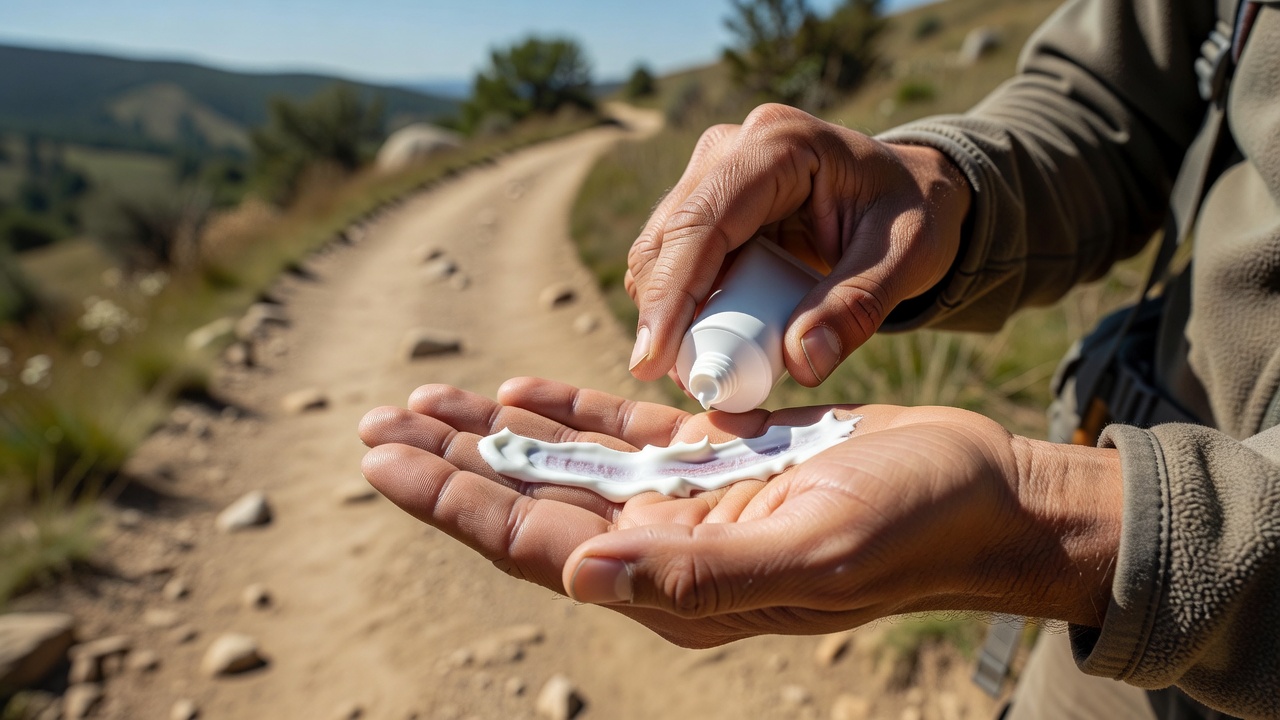
Instead of relying on a single thin swipe of high-SPF lotion at breakfast, dermatologists recommend the "two-coat" or "two-finger" approach. For the face, ears, and neck alone, squeeze two full-length strips of sunscreen along your index and middle fingers (roughly half a teaspoon or 2.5 ml). Apply one layer before getting dressed so you do not miss the edges of swimwear or shirt collars, allow it to set for 10 to 15 minutes, and smooth a light second pass over high-exposure zones like the bridge of the nose, tops of ears, cheekbones, and back of the neck.
Mineral and organic UV filters in active environments
Sunscreen formulations use either inorganic (mineral) filters—zinc oxide and titanium dioxide—or organic (chemical) filters such as bemotrizinol (Tinosorb S), bisoctrizole (Tinosorb M), avobenzone, octisalate, and ethylhexyl triazone, or a hybrid of both. Both categories absorb and scatter UV energy effectively when formulated to broad-spectrum standards.
For surfers, sailors, and high-output hikers who sweat heavily around the forehead, mineral sticks or modern non-stinging polymer emulsions around the orbital bone help prevent sunscreen migration into the eyes. If you have sensitive or wind-chapped skin, fragrance-free mineral or modern high-molecular-weight filter creams often feel calmer upon application.
Four habits for reliable daytime sun protection
Check the UV Index Daily
Consult national meteorological reports (such as the Met Office, Bureau of Meteorology, or NOAA). Begin structured sun protection whenever the forecast UV Index reaches 3 or above, even if temperatures feel cool or breezy.
Anchor With UPF Apparel
Put on a long-sleeved UPF 50+ rash guard, sun hoodie, or tightly woven trek shirt first. Clothing never washes off in a wave or rubs off on a backpack strap.
Apply 20 Minutes Before Exposure
Spread a generous, even coat onto dry skin before leaving shelter so film-forming resins bind properly before perspiration begins.
Reapply Every 2 Hours & After Towelling
Set a simple watch reminder. After swimming or heavy sweating, pat skin dry and replenish a full coat across all exposed zones, including lips with an SPF 30+ balm.